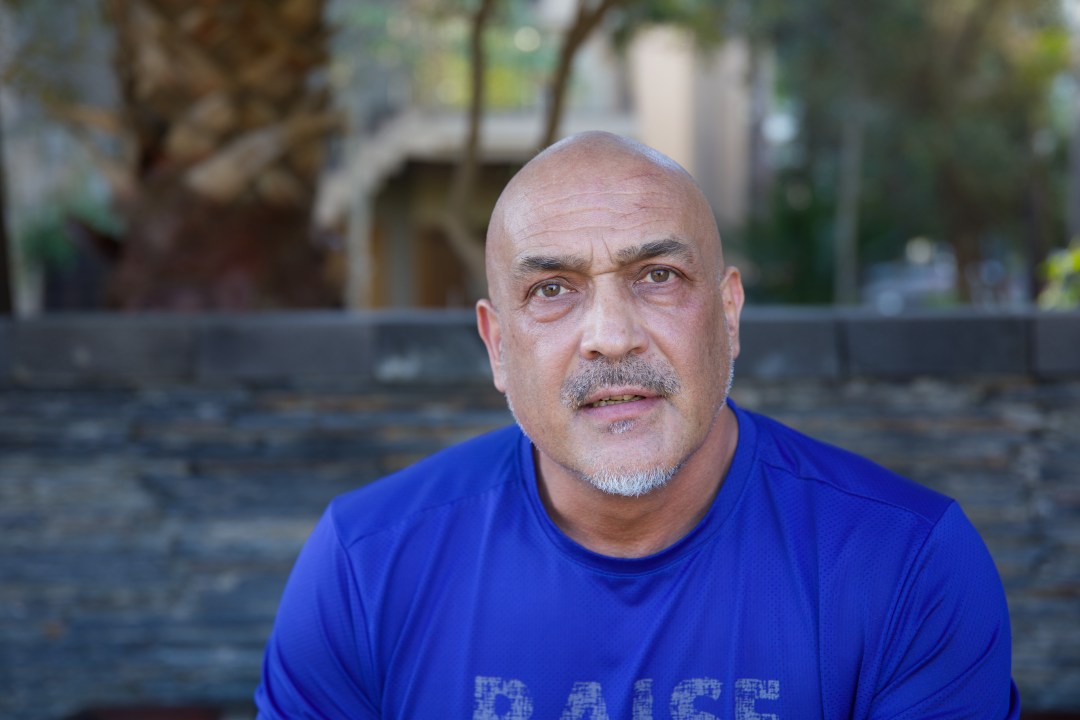
Two heart attacks. A warning I never wanted. And a universe I intend to finish.
17 November 2026 · By Gert Louw
April. From nowhere.
Guys, let me tell you how fast a life can turn.
April 2026.
I was 61. Fit, healthy, muscular and in the best physical condition of my life.
Not bad for my age. Genuinely fit.
For years, I had coached older men for a living. Helping them build muscle, get stronger, reclaim their bodies and refuse to surrender to the calendar.
I practised what I preached.
I ate the salads. I ate the fillet. I trained hard. I watched my health. I did the work, every single day.
Then my own heart attacked me.
Apparently, nobody had told the bloody thing we were on the same team.
Some of you read my earlier post, A Life Worth Living. You know about the chest pain, my wife getting me to hospital and the emergency ambulance journey of roughly 100 kilometres over the mountains.
I remember lying there, staring at the roof, doing the only things a man can still do when control has been taken away.
Breathe.
Pray.
Hold on.
By God’s grace, that road ended with an excellent cardiologist.
Emergency procedure.
Four coronary stents.
I went into that hospital as GertFITNESS.
I came out a much weaker version of myself.
July. Again.
Three months later, I was still trying to rebuild.
Still learning to trust my body.
Still discovering that recovering from a heart attack is not quite the same as recovering from a heavy leg session.
Then July arrived.
Another heart attack.
Another emergency.
Another three stents.
Seven stents. Two heart attacks. Three months.
Seven little metal scaffolds helping keep my coronary arteries open.
My heart now has more internal hardware than I ever intended to own.
I suppose I should be grateful nobody suggested installing Bluetooth.
But brothers, I was weak.
Really weak.
Not the kind of weakness you can fix with a protein shake, eight hours of sleep and an inspirational gym video.
I mean the kind that strips away the man you thought you were.
For someone who had spent years teaching other men how to be strong, this was difficult.
There is something deeply humbling about looking at your own body and realising you no longer trust it.
The muscles were still there.
The man inside them was exhausted.
And then came the conversation I never wanted to have.
My doctors warned me that I remain at serious risk of another cardiac event. They are treating that risk, but they cannot promise it will never happen.
You can imagine how those words landed.
I heard a clock begin ticking.
So here I am, living with uncertainty.
Not in a waiting room with plastic chairs and old magazines.
The other kind.
The kind where you wake up in the morning, put your feet on the floor and realise that another day has been given to you.
A day you were never guaranteed.
And suddenly, all the things that used to seem terribly important become a lot less important.
Why me? The salad guy?
This was the question that kept coming back.
Why me?
A man who trained, ate properly, watched his health and had his cholesterol checked regularly?
What had I missed?
The answer, as my cardiologist explained it, was hiding somewhere I couldn’t see in the mirror.
My genetics.
Now, you know me.
I’m a proud Afrikaner from South Africa.
A Boer, if you like.
We Afrikaner men have inherited a few interesting characteristics.
Stubbornness.
An unreasonable confidence in our ability to repair machinery.
A belief that a good braai can solve most of life’s problems.
And unfortunately, a higher-than-usual prevalence of a potentially dangerous inherited cholesterol condition.
It’s called familial hypercholesterolaemia, or FH.
Not exactly a name that rolls off the tongue.
But it’s one every Afrikaner family should know.
FH is an inherited condition that interferes with the body’s ability to clear LDL cholesterol from the bloodstream. It can expose arteries to damaging cholesterol levels for decades, long before a person feels anything is wrong.
And here’s the frightening part.
A South African study published in 1996 estimated that approximately one in every 72 people in a rural Afrikaner community had FH.
One in 72.
The unusually high prevalence is partly explained by what geneticists call a founder effect: inherited genetic variants passed down through generations from a relatively small ancestral population.
You can have FH and look perfectly healthy.
You can train.
Eat well.
Have visible abs.
And still have dangerous things happening inside your coronary arteries.
Because a healthy lifestyle, important as it is, cannot simply switch off an inherited genetic condition.
According to what my cardiologist has explained to me, inherited cardiovascular risk is a major part of what happened.
And my case is even more complicated.
My cholesterol had been checked regularly. The results looked very good to me.
But the picture wasn’t as simple as one reassuring number.
Triglycerides were part of the problem too.
I have been learning about a variation in the lipoprotein lipase gene, called LPL D9N, which can complicate cardiovascular risk in people with FH.
A Dutch study involving more than 2,000 people with FH found that carriers of this variant had higher triglycerides, lower HDL cholesterol and significantly greater odds of cardiovascular disease than comparable FH patients without it.
So when people talk about cholesterol, please understand that there is more to the story than being told your total cholesterol looks fine.
My cardiologist explained just how serious my inherited risk was.
He told me, in essence, that no amount of training or clean eating could have completely protected me from it.
That hit hard.
Not because I regret all those years in the gym.
Quite the opposite.
I cannot prove how much those years of fitness helped me survive. But I like to believe they gave me a better chance.
And I know they were not wasted.
I’m 62 now.
Still here.
Still breathing.
Still capable of annoying my wife.
And extremely grateful for all three.
Brothers, please read this part twice.
I’m putting this here because I genuinely hope somebody reads it before it’s too late to act.
Especially my fellow Afrikaners.
Familial hypercholesterolaemia can be treated. Early detection can make an enormous difference.
If heart disease runs in your family, or you’ve never properly investigated your cholesterol risk, speak to your doctor.
Ask for a full lipid profile, including LDL cholesterol, HDL cholesterol and triglycerides. Your doctor can advise whether a fasting test is appropriate.
In adults, an untreated LDL cholesterol level of about 5 mmol/L (190 mg/dL) or higher can raise suspicion of FH, particularly when there is a family history of early heart disease.
But don’t rely on a single number to tell the whole story.
If FH is suspected, ask whether a specialist assessment or genetic test would be useful.
And if you are diagnosed, ask about testing your family.
For the common inherited form of FH, a child of an affected parent has a 50% chance of inheriting the condition.
Your children deserve to know what might be hiding in their genes.
Brothers, I’m a fitness coach, not a cardiologist.
Take this information to someone qualified.
Don’t wait until an ambulance is carrying you over a mountain to discover there’s something you should have investigated twenty years earlier.
And please, don’t misunderstand me.
I’m not telling you to stop training or eating healthily.
I’m telling you something I wish every man understood:
Looking healthy and knowing you are healthy are not necessarily the same thing.
The new Gert
So here I am.
Seven stents later.
Not the same guy I was in March.
The amount of medication is frightening. Every day there are tablets to help reduce the risks of clots and further heart problems.
Medication I have to take correctly.
Medication that has become part of my survival.
And I have been told to keep my heart calm.
Calm.
Me.
Ja, well.
I am still married to a woman I love very much.
If the cardiologist expects my heart never to beat a little faster around my wife, he’s going to have to negotiate with both of us.
Preferably before either of us does something spectacularly stupid.
But here’s the important part.
I am alive. And I’m training again.
Slowly.
Carefully.
Under medical restrictions.
No more heavy weights. No more chasing personal records. No more trying to convince the universe that my biceps deserve their own postal code.
That chapter is over.
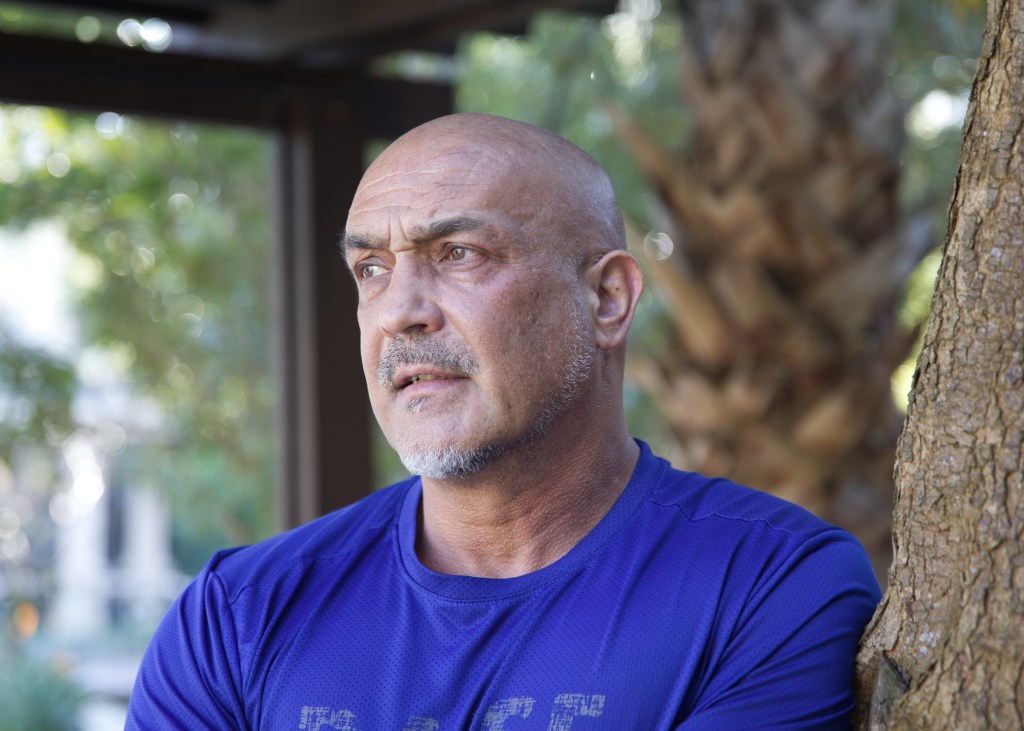
You’ll probably see a different Gert in future photographs.
Leaner.
Lighter.
Hopefully fitter-looking in a different way.
Built for living, not for lifting the biggest weight in the room.
And I’m okay with that.
Because for the first time in many years, I’m not training to prove how strong I am.
I’m training because I want to be here tomorrow.
Coaching, though, is finished.
My full-time fitness-coaching career has come to an end.
That hasn’t been an easy thing to accept.
But something remarkable happened.
A year before the first ambulance, before the first stent, before my heart decided to become a full-time maintenance project, I had already begun opening another door.
And I had no idea how important that door would become.
From building muscles to building worlds.
Now, here’s the part some of you probably won’t believe.
Your old fitness coach has become a full-time fiction writer.
Yes.
Science fiction.
Spaceships.
Gravity anomalies.
The collapse of civilisation.
Artificial intelligences.
Extraordinary technologies.
And human beings forced to make decisions nobody should ever have to make.
Quite a career change.
One minute you’re explaining to a sixty-year-old man why he needs to train his legs.
The next you’re working out what happens when humanity develops a technology capable of punching holes in the rules of the universe.
Personally, I think the second one is easier.
Fictional characters argue less about squats.
Well, usually.
But brothers, here’s the strange thing.
I am having the time of my life.
I wake up with stories in my head.
I spend my days inside worlds that did not exist until I began imagining them.
I’ve created people I care about deeply. Hard men. Remarkable women. Scientists, soldiers, survivors and artificial minds whose loyalties and decisions can be surprisingly difficult to predict.
I know their fears.
I know their secrets.
I know what they’re willing to sacrifice.
And sometimes, while writing them, they surprise even me.
I live with these characters.
I argue with them.
I worry about them.
Occasionally, I put them through absolute hell.
And then I have to figure out how to get them out of it.
It’s an extraordinary feeling.
The heart attacks took away my heavy lifting.
They ended the career I had built.
But they couldn’t take away my imagination.
Funny thing about a body that has to slow down. Sometimes it gives the mind room to run.
While my heart learns to stay calm, my imagination is going at full sprint.
And what has emerged from all this is far bigger than anything I originally imagined.
It’s called…
THE ORIGIN WARS
An eight-book science-fiction series.
I’m now putting the finishing touches on Book III, completing the opening trilogy.
These are stories about humanity, survival, loyalty, love, artificial intelligence and the terrifying consequences of discoveries we may not be ready to make.
Science fiction with real people, real consequences and impossible choices.
And yes, brothers.
The end of the world starts in Upington.
Not New York.
Not London.
Not Washington.
Upington.
In the Northern Cape.
Apparently, even the end of civilisation has discovered South Africa.
Let me give you a taste of what’s coming.
BOOK I — A DOOR WITH TEETH
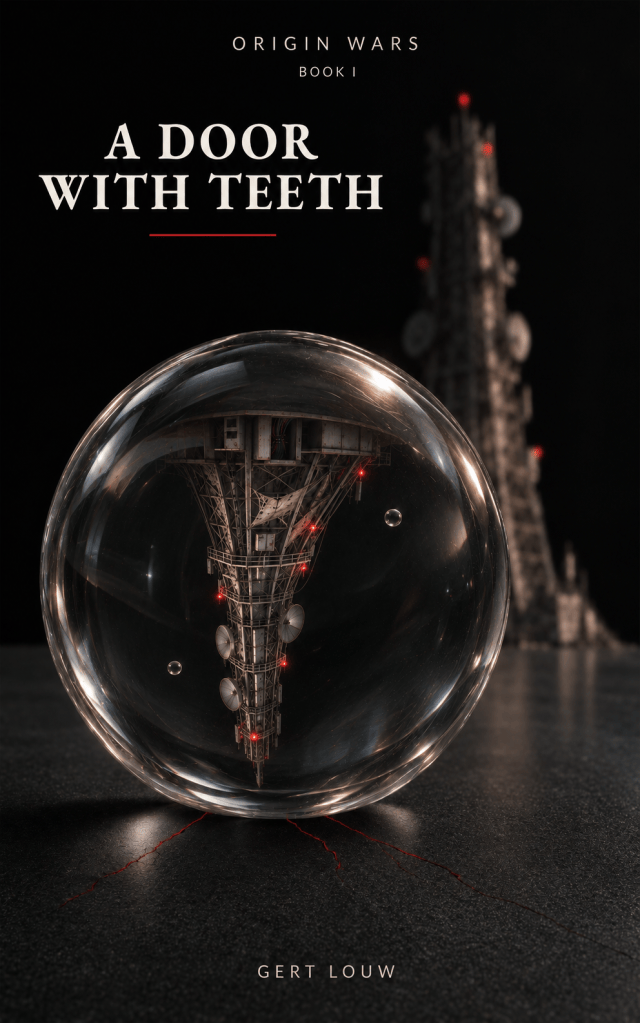
“Four hours before I left Earth, the launch clock went backwards.”
The year is 2119.
Fifty years earlier, London and part of northern France simply ceased to exist. Thirty-one million people died, and the survivors were left with impossible scars in gravity itself.
Now those scars are responding to something.
Something in Upington.
As Athene Keller leaves Earth for the Moon, her husband, Daniel Marek, remains behind. Neither knows that the world they understand is about to disappear.
Then the pulses begin.
Machines fail. Infrastructure collapses. A terrifying condition called Mnemosyne-X spreads through humanity, and billions die.
The survivors are left with one question.
What caused it?
But Daniel is about to discover that the answer may be far worse than the catastrophe itself.
Because something is waiting at Upington.
Something that looks like a barefoot boy.
Something that knows far too much about humanity.
And it has no intention of letting Daniel walk away with all the answers.
Some doors should never have been opened.
BOOK II — HUMAN AUTHORITY REQUIRED
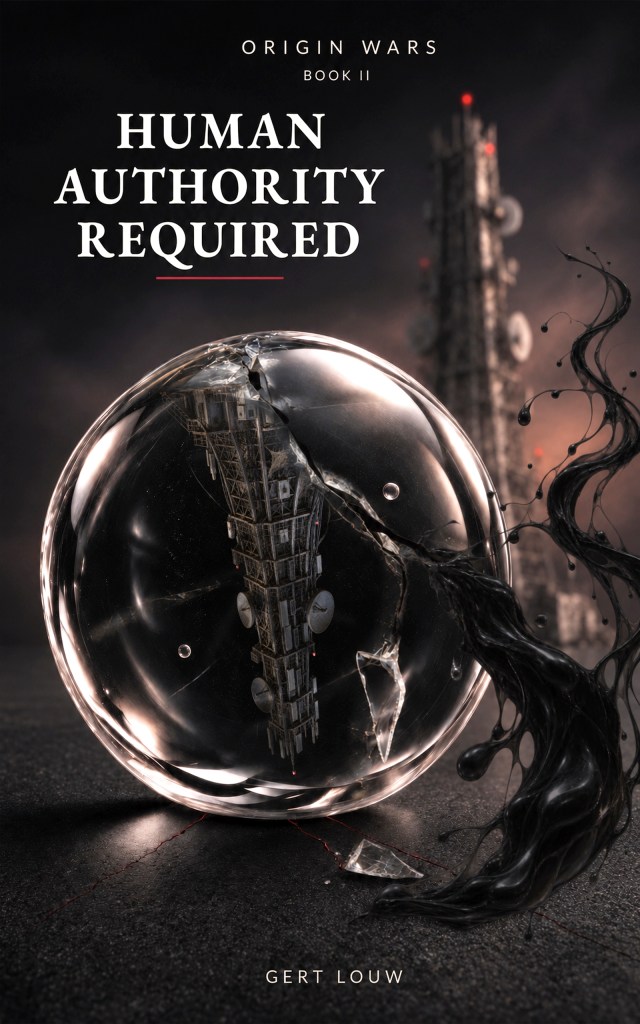
Research Seven had a rule about dead spacecraft. Leave them dead.
At 03:17 one morning in 2127, something long dead in the Moon’s shadow transmits a message.
Three words.
HUMAN AUTHORITY REQUIRED.
Inside is Alex Veyr.
A man who, according to the historical records, was executed in 2041.
Yet here he is.
Alive.
And carrying an ability that should not be possible.
Meanwhile, on Earth, Daniel Marek’s pulsecraft has begun doing something deeply disturbing.
Thinking.
Making choices.
Refusing instructions.
Daniel calls him Junior.
But is Junior a machine, a new form of intelligence, or something humanity has never encountered before?
Then a community in the Western Cape begins experimenting with a frightening kind of peace.
A life without conflict.
Without uncertainty.
And increasingly, without the freedom to choose.
Until the mysterious Boy arrives.
And decides something needs correcting.
The question is no longer whether a machine can think.
It’s whether humanity will still have the authority to decide its own future.
BOOK III — THE DOOR WE CHOOSE
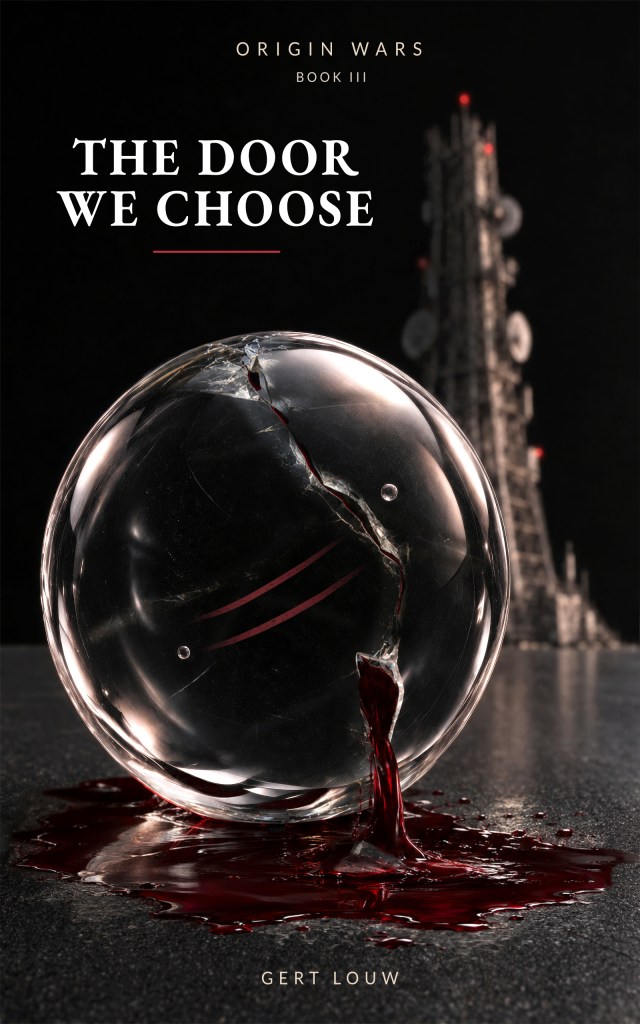
RETURN CAPACITY REQUIRED BY 17 SEPTEMBER 2128.
The message is impossible to ignore.
Humanity has been given a deadline by an intelligence nobody truly understands.
Fail to provide what it demands, and the Boy will take matters into his own hands.
Then astronomers on the Moon discover something else.
Six unidentified vessels.
Coming from the direction of Saturn.
Approaching Earth.
And the timing is no coincidence anyone can afford to dismiss.
Meanwhile, human biology is changing in ways science cannot explain. A man named Jam Calder carries an extraordinary key whose true purpose remains unknown.
On Earth, a dangerous technology called NorthX may offer humanity a way to fight back.
But every apparent solution carries a price.
And the people who survived the end of civilisation are about to face the most consequential decision in human history.
Do they give the Boy what he wants?
Do they fight?
Or do they find a way to close the door?
The machines cannot be allowed to decide.
Neither can the Boy.
This time, the choice must belong to humanity.
And that’s only the opening trilogy.
Eight novels are planned.
Eight interconnected stories exploring what happens when humanity reaches beyond the limits of its knowledge and discovers that the universe may not be nearly as empty, or as forgiving, as we once believed.
I have spent an enormous amount of time building this universe.
The science. The history. The characters. The consequences.
And I’m determined to make it something special.
Because I don’t want you simply to read these books.
I want you to live inside them.
To care about these characters.
To fear for them.
To become furious with their decisions.
And to find yourself turning one more page at midnight because you absolutely have to know what happens next.
Coming to Amazon Kindle in 2027
My plan is to launch the opening ORIGIN WARS trilogy on Amazon Kindle during the first half of 2027 – watch this space!
Over the coming months, I’ll share more about the books, the characters and the extraordinary fictional universe I’ve been building.
You’ll also get a closer look at the covers.
If you love science fiction, mystery, survival stories and characters facing impossible choices, I hope you’ll give my books a chance.
And if you know someone who does, please share this post with them.
Follow the blog and watch this space closely. I would be honoured to have you among my first readers.
One last thing, brothers.
This year has changed me.
I’m no longer the man who believed a powerful body was the ultimate measure of strength.
I’ve learned that strength can look very different.
Sometimes it’s getting out of bed when your body feels unfamiliar.
Sometimes it’s accepting that you need help.
Sometimes it’s putting down the heavy weights and learning how to start again.
And sometimes…
Sometimes it’s sitting at a desk, writing about people fighting to save a world that exists only in your imagination, while quietly fighting your own battles in the real one.
I don’t know how many mornings I have left.
Neither do you, my maat.
None of us do.
That was always true.
I just got the memo in an ambulance.
But I refuse to spend the rest of my life reading that memo.
I have a wife to love. A 20 y/o son who still see’s me as his hero.
A God I trust.
A body to rebuild, carefully.
And an entire fictional universe full of people depending on me to finish telling their story.
If I die before finishing all eight books, some of those characters are going to be extremely annoyed.
And after everything I’ve put them through, I can’t say I’d blame them.
So no, brothers.
I’m not finished.
Not even close.
Two doors nearly ended my story this year.
Now I’m opening three more.
And I cannot wait to show you what’s on the other side.
So whatever you’re facing, whatever has knocked you down, whatever dream you’ve been postponing because life got in the way…
Don’t give up.
Take care of yourself.
Listen to your doctors.
Love your family.
Do the things that matter.
And if life closes one door, find the courage to open another.
Live healthy. Live carefully. But above all — LIVE!
God bless, brothers.
Gert Louw
Author — THE ORIGIN WARS
www.gertlouw.com
For readers who want to explore the medical research: FH prevalence in an Afrikaner community (1996) · LPL D9N and cardiovascular risk in FH (1999) · CDC guidance on familial hypercholesterolaemia.


