ORIGIN WARS / PRE-PUBLICATION READING ROOM
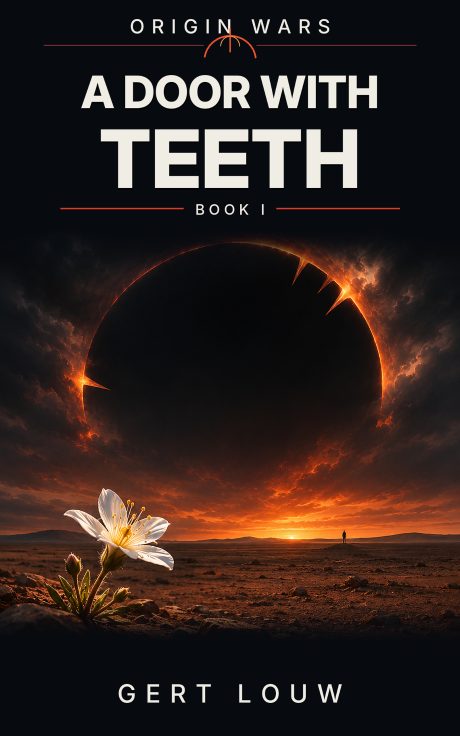
Some mistakes leave no record.
Four hours before Athene Keller leaves Earth, a launch clock moves backwards. The log insists it never happened. Her husband, Daniel, has a habit of checking the handle even when someone tells him the door is locked.
Read the complete opening chapter of A Door with Teeth, the first novel in the Origin Wars launch sequence. No signup is required to read.
Adult hard science fiction · South Africa to Luna · Survival, loyalty and the danger of machines that rewrite their own mistakes.
CHAPTER ONE · APPROXIMATELY 10 MINUTES TO READ · NO SIGNUP REQUIRED
Chapter One — Four Hours
30 October 2119 · Cape Town Zone to Luna · Athene
Four hours before I left Earth, the launch clock went backwards.
Only for a fraction of a second. No alarm sounded. Nothing in the room so much as flickered.
Daniel was on one knee beside the bed, hunting for my missing launch sleeve, when the digits above the door changed from 04:03:17 to 04:03:18.
Then corrected.
04:03:16.
The room was still warm from us. The sheet was half on the floor, a pillow had been shoved against the wall, and there was a faint red mark low on his shoulder where my mouth had been. We had been leaving versions of ourselves in rooms like this for years: launch-week rooms, borrowed rooms, rooms with somebody else’s soap in them. My hand was already reaching for my slate. I hated that about my hand.
Daniel came up from under the chair with the sleeve and held it out like evidence.
“It was under the chair.”
“Then the chair put it there.”
“You threw it at the chair.”
“I threw it at you. You moved.”
He stood, saw the slate in my hand, and looked where I was looking.
04:03:09. 08. 07.
It was counting down normally again.
“You’re checking the clock history,” he said.
“It won’t be there.”
He opened the wall display anyway. That is Daniel. Tell him a door is locked and he will still try the handle, not because he doubts you, but because he thinks the handle deserves a fair hearing.
The log was clean. No correction, no missing second, no reversal. He checked the room system, then the local launch feed, and came back with nothing.
“It happened,” he said.
“Yes.”
“And the system didn’t record it.”
“No.”
He turned round slowly.
“You knew it wouldn’t.”
“Yes.”
“How?”
“Because Luna has seen it before.”
“How long?”
“Four years.”
“Four years.” He didn’t make it a question. He put it down between us the way he put down a part he’d taken out of an engine, so I could look at it properly.
“We sent the faults Earthside,” I said. “They were filed as noise. We kept measuring.”
Four years of not telling my husband something because it had not yet become a finding. I had a good reason for every one of those years. I could have listed them for him in order. I didn’t, because he would have let me finish, and that would have been worse.
I reached for the sleeve. He kept hold of it.
“Athene.”
“Don’t do the jaw thing.”
“This is my face.”
“It gets worse when you’re angry.”
I got the lining halfway up my arm before he took it back, straightened the seam and held it open for me, the way he had before every launch I had ever made. I let him. We had been married long enough for tenderness to acquire practical jobs.
He pulled the cuff flat over my wrist with his thumb.
“What changed?”
“The drift found a direction.”
“Where?”
“Upington.”
Everyone knew what 2069 meant. London hadn’t burned or fallen. It had simply stopped existing. A second void had taken part of northern France the same way. Thirty-one million people were gone. For fifty years the gravity scars around those two absences had been damage, something you fenced, measured and wrote careful reports about. Now the damage had a direction, and the direction ended at a small town on the Orange River.
Daniel picked his shirt off the floor and put the first button through the wrong hole.
I told him. He kept buttoning.
“Three days ago Nicholas asked me whether the northern scars were still converging,” I said. “When I asked him why, he called it hypothetical.”
Daniel gave a short laugh with nothing funny in it. “Nicholas doesn’t waste hypotheticals.”
“No.”
“So what’s in Upington?”
I looked at the clock instead of at him. “We’ve been calling it a destination, because the readings keep pointing there.”
“And you don’t think it is.”
“I think that may be too simple.”
“Then what is it?”
“I don’t know yet.”
He finished the last button. Wrong all the way down.
“And you’re still leaving.”
“Yes.”
“Of course you are. Luna has the better instruments. Earth has the problem.” He did up his cuff. “And me.”
“Yes.”
“Good. Nice to stay useful.”
“That isn’t what I meant.”
“I know what you meant.”
We left six minutes late.
Pieters had the GPV waiting outside. He looked at us once, found something urgently interesting on the far side of the vehicle, and opened the hatch.
Daniel took the controls. The GPV came off the ground so cleanly that the dust beneath it barely stirred, which was his way of showing off without being caught at it.
Cape Town dropped away behind us. Hex River grew ahead: mountain, launch infrastructure and the great throat cut through stone that fed everything humanity had put above the atmosphere and then learned to need.
At launch control, a controller stopped halfway through an answer about lunar capture timing.
His mouth stayed open. His right hand hung over the panel.
Daniel moved before anyone else, but not towards the man. He stepped sideways until he could see the controller, the timing strip and the main route stack at the same time.
The controller blinked, very slowly. Then he carried on from the middle of his sentence.
The room let him.
Nicholas stood at the central table. “Minov. Stop.”
Minov stopped. Recognition came back into his face a beat late.
“Start again.”
Minov swallowed. A thin line of blood had appeared beneath his left nostril. He wiped it with the back of his hand, looked at the red and said, “Lunar handoff timing remains inside safe tolerance.”
His voice sounded normal. His right hand didn’t. It trembled above the panel.
Nicholas looked round the room. “If something behaves incorrectly, say so.”
Two technicians found their boards very interesting. Nobody named a fault.
“If your first instinct is to protect procedure from reality, you’ve already joined the failure.” He turned back. “You’re off live launch sequencing, Minov. Now.”
A technician opened the incident form. The first label the system offered was:
SEQUENCE ANOMALY
It vanished before anyone approved it. The replacement came back smaller.
PERSONNEL PERFORMANCE INTERRUPTION
TIMING SYSTEMS: NO ACTION REQUIRED
Minov still had blood on the back of his hand when the system decided the problem was him.
“That is how clean records begin,” Daniel said quietly.
I looked at the new label. “By putting it on him.”
“Yes.”
I showed him the raw timing trace on my slate. It had stepped backwards twice while Minov froze. The stored history insisted nothing had happened.
Daniel read it twice, his thumb moving down the margin.
“That’s not nothing.”
“What is it?”
“The system is excluding the fault.” He spread the trace with two fingers. “A normal correction leaves evidence somewhere. Noise. A mismatch. Two layers that don’t agree. Here every record agrees that nothing happened. I’ve never seen records agree that well about anything.”
He handed the slate back. Through the glass, Minov was being walked out with gauze under his nose.
“You felt it,” I said.
He took his time. “Like a step missing from a stair I use every day.”
I waited.
“Small enough to hide,” he said. “Big enough that I noticed.”
Four years of lunar anomalies stopped looking like unrelated warnings.
Nicholas was already moving on. Above him, the timing display behaved perfectly. That was becoming the problem.
Twenty-three minutes before boarding, Daniel found me on the observation tier.
Below us the pod cradle waited under white light. Restraint frames stood open. Technicians moved quickly while pretending they weren’t.
“You still haven’t told Nicholas.”
“No.”
“He saw Minov.”
I took the sealed data wafer out of my sleeve. His eyes dropped to it.
“What is that?”
“The scar progression. The Upington correlation. The assays. Raw timing faults, saved before the systems removed them from the official history.”
“You brought that Earthside?”
“Only this copy.”
His face tightened. “Athene.”
“I know.”
“You say that a lot today.”
“You’ve found a lot to object to.”
He held out his hand. I gave him the wafer.
“No network copy,” I said. “No central indexing unless you choose it.”
“And if Nicholas asks?”
“You decide.”
“That is a very ugly present.”
“I was leaving.”
Below us, one restraint frame closed, tested, opened.
“I don’t trust the clean records any more,” I said.
He turned the wafer over between two fingers. “Neither do I.”
“If something changes and the system says it didn’t, believe what you saw first.”
“That advice can get people killed.”
“So can trusting a record that has already erased the problem.”
He put the wafer in an inner pocket.
Then his hand came to the back of my neck, the place he always touched when one of us had run out of useful language.
“You’re sure.”
“Yes.”
“I hate that.”
“I know.”
He was still angry with me. He stayed anyway.
His forehead touched mine. My hand settled on his shoulder, a shape I knew from too many departures and borrowed rooms. For one second I wanted a morning when neither of us had to leave. I wanted it so exactly I could have written the specification.
My fingers found one of the old scars under his shirt. Daniel caught my wrist and held my palm flat against the raised line, making me feel it properly before he let go.
“You don’t have to be brave,” he said.
“I’m not brave.”
“What are you?”
“Late.”
A breath went out of him that was nearly a laugh. I kissed him, and when we came apart he stayed close, and I said the thing I had been holding since the clock went backwards.
“Come back in the right order.”
My voice caught on right. I was the one leaving. He knew what I meant anyway.
“I intend to,” he said.
The boarding tone sounded.
We had an old rule about departures: once one of us had to move, no second look. One look was enough to say what neither of us trusted ourselves to say twice.
I broke it.
Daniel was still behind the observation glass, one hand on the rail where mine had been. He didn’t wave. Neither did I.
I looked back once. Then I turned towards the pod.
The Vector Launch Array made sure I felt every stage of leaving Earth.
The first ring drove the restraint frame into my ribs. The second came early. Not by much, but enough that my body had already begun to release into the gap that should have been there, so the load hit before I had braced again and my teeth went into the inside of my cheek.
The pod display showed the second ring exactly where it belonged.
I tasted blood and watched the log agree with itself.
The remaining rings came on schedule. My body stopped trusting the gaps anyway.
Then quiet. Earth behind me, Luna ahead, and forty-two hours with nowhere useful to put the things I had not said to my husband.
* * *
Luna smelled of warm filters, scrubbed metal and bread. Somebody had started experimenting with bread again, and from the smell, losing.
A child’s drawing had been taped beside the routing board: Earth in blue, Luna in grey, five stick people holding hands between them. Someone from fabrication had written underneath:
BAD STRUCTURAL ASSUMPTION. GOOD SPIRIT.
“Commander Keller.” An officer caught me before I had been back four minutes and handed me a routing stack. “Capture timing drift.”
“Of course.”
“Agriculture misses its window if we keep Earth timing.”
“Move them six degrees off it and give them local discretion.”
My private slate opened without a tone.
Jaco.
COME NOW.
NOT LATER.
I stopped walking. Another line appeared.
THE SCARS STOPPED.
Then the last one.
UPINGTON.
The clock was only the beginning.
What happened at Upington would change the world. For the people who survive, the harder question is whether they can still choose what happens next.
Books I–III are planned for Amazon Kindle in the first half of 2027. Subscribe below for confirmed release information and links when the books become available. Select Origin Wars Book Updates in the subscription choices for book-focused emails.
Explore all three books · Volunteer as a cold reader
© 2026 Gert Louw. Pre-publication reading excerpt; text and release plans may be updated before publication.

